$6,500. That’s the Canadian average for braces.
Some people pay $3,000. Others walk out owing closer to $10,000. The gap comes down to where you live, what type you pick, and what your teeth actually need done. This guide uses real provincial fee data to give you numbers you can plan around.
One thing worth knowing before we get into it — braces aren’t just a teenager thing anymore. In some Canadian clinics, close to 1 in 5 patients getting orthodontic treatment is an adult.
Braces Cost in Canada
Your type choice is the single biggest factor in your total bill.
| Type | Without Insurance | With Insurance |
| Metal | $3,000 – $7,000 | $1,500 – $3,500 |
| Clear Aligners | $4,000 – $7,400 | $2,000 – $3,700 |
| Ceramic | $4,000 – $8,000 | $2,000 – $4,000 |
| Lingual | $8,000 – $10,000 | $4,000 – $5,000 |
Insurance figures assume roughly 50% coverage, which is standard, but your plan may be higher or lower. Check before assuming.
How Much Does Braces Cost in Canada — By Province
Same treatment. Completely different price tag depending on the province. These numbers come from Canadian provincial dental fee guide data and reflect the least complex procedure, excluding lab and material costs:
| Province | Estimated Cost |
| Alberta | $9,576 |
| British Columbia | $14,085 |
| Manitoba | $8,131 |
| New Brunswick | $16,573 |
| Newfoundland & Labrador | $10,398 |
| Nova Scotia | $10,290 |
| Ontario | $7,604 |
| Prince Edward Island | $3,867 |
| Quebec | $18,686 |
| Saskatchewan | $8,521 |
Ontario at $7,604 is realistic for most patients in Richmond Hill and York Region. BC regularly exceeds $10,000 — high clinic overhead pushes everything up. PEI is the most affordable province nationally. Quebec’s number looks high because of how the fee guide calculations compound for complex procedures.
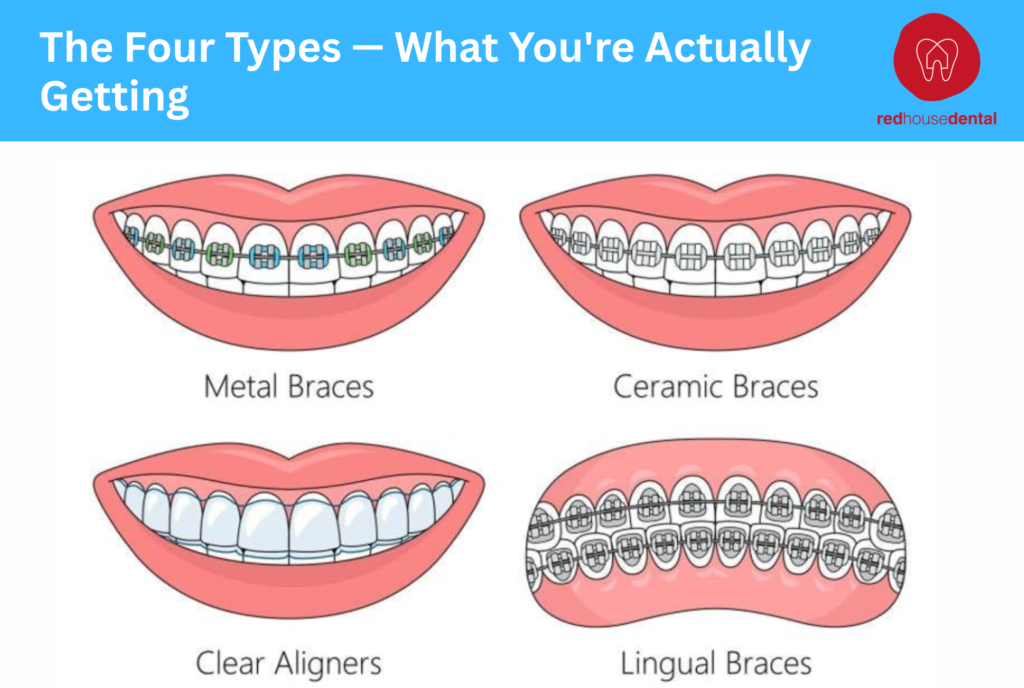
The Four Types — What You’re Actually Getting
Metal braces — $3,000 to $7,000
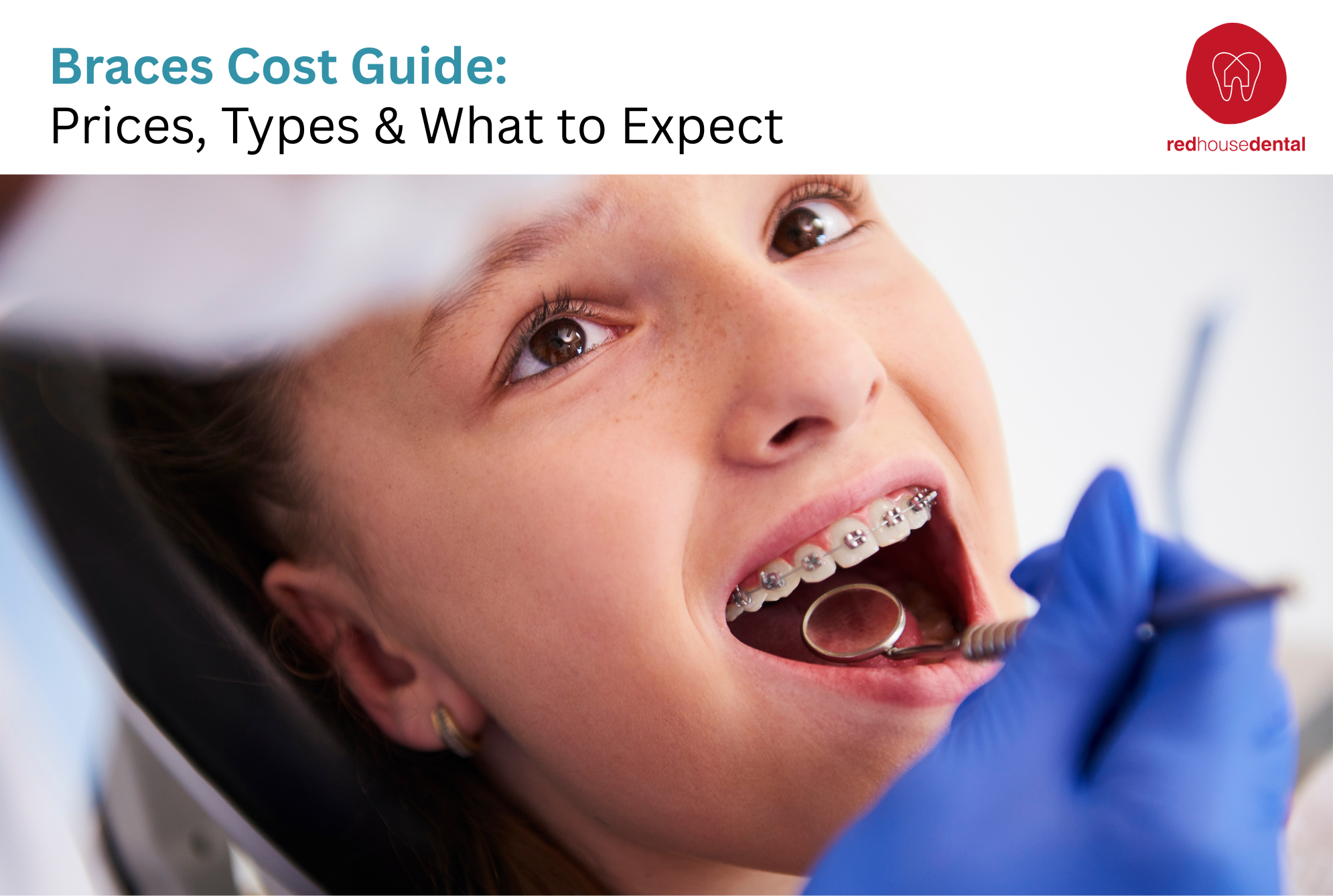
Metal brackets glued to each tooth, connected by wires, held with small elastic bands. Most durable option. Handles any level of misalignment. Doesn’t discolour. Takes 1 to 3 years.
They’re visible. That’s the trade-off. For patients who need heavy correction, though, they’re often the most dependable choice and the lowest cost.
Clear aligners — $4,000 to $7,400
Removable trays. Nearly invisible. You swap to a new set as teeth move, so fewer in-clinic adjustment visits. Treatment is usually 1 to 2 years. General dentists handle mild-to-moderate clear aligner cases now, which sometimes means lower fees than seeing a specialist.
The catch: you have to wear them. 20-22 hours a day. Patients who take them out constantly don’t finish on time, sometimes not at all.
Ceramic braces — $4,000 to $8,000
Same mechanics as metal. Brackets on the front of teeth, wires between them. Ceramic is tooth-coloured so they’re far less noticeable. Still fixed, can’t remove them yourself. The brackets hold up fine, but the elastic bands around them stain easily. Coffee and red wine drinkers notice this fast if they’re not cleaning properly. Treatment: 1 to 3 years.
Lingual braces — $8,000 to $10,000
Brackets and wires are attached to the inside surface of the teeth. Completely hidden. That’s the point.
They cost the most because placing hardware behind each individual tooth is technically harder and takes longer. Not every clinic offers them. Cleaning is difficult because the brackets sit in the tightest spots in your mouth, making daily flossing even more important. Treatment still runs 1 to 3 years.
What Affects the Cost of Braces in Canada?
Who treats you? A general dentist and an orthodontist aren’t priced the same. Within orthodontists, experience level moves the number too. Someone who’s handled hundreds of complex jaw cases charges more than someone who hasn’t. Urban clinics carry higher overhead than suburban or rural ones — and that gets passed to patients. In York Region and Richmond Hill, you’re generally paying less than downtown Toronto for the same quality of care.
Technology at the clinic. 3D digital scanning, computer-aided design, laser technology — clinics that run this equipment charge enough to cover it. The benefit is more precise treatment planning. Whether it matters to your case specifically is worth discussing with your dentist.
How complicated your teeth are. A mild spacing issue and a severe overbite involving jaw correction are nowhere near the same price. Some cases need palate expanders, spacers, or surgical intervention alongside braces. Each added step adds to the total.
Your age. Kids and teens cost less to treat — growing jaws respond faster. Adult bone is fully developed, which can mean longer treatment and more complexity. Starting orthodontic treatment early in childhood sometimes avoids much more expensive correction later.
Time in treatment. Every adjustment visit costs money. A 12-month case and a 30-month case are not the same bill, even with the same type of braces.
Needing it done again. Retainers wear out. Patients who stop wearing them consistently see their teeth shift back — orthodontic relapse. When it’s significant enough, it means starting treatment over. That’s the whole cost again.
Does Insurance Cover Braces?
Most Canadian dental plans cover about 50% of orthodontic costs. Almost all of them cap the total payout — often somewhere between $1,500 and $3,500 lifetime. Once you hit the cap, the rest is yours.
Say braces cost $5,000. Your plan covers 50%, capped at $2,000. You pay $3,000 — not $2,500. The cap matters more than the percentage in a lot of cases.
Adult coverage is patchier. Some plans cut off orthodontic benefits past a certain age. Others offer partial coverage. Read your actual policy — don’t assume it works the same as a family member’s plan.
The CDCP doesn’t cover cosmetic orthodontics. Limited coverage exists only for cases deemed medically necessary under strict criteria. Most patients don’t qualify for that. At Red House Dental, we accept the CDCP for eligible treatments and will tell you exactly what’s covered at your first visit.
Ways to Pay
- Payment plans: Many clinics spread payments across your treatment period. At Red House Dental, we work with patients to make this manageable. A rough example: $5,000 treatment, $1,000 down, $222/month over 18 months at 0% interest. Ask us about the actual numbers for your case.
- Health Spending Account (HSA): Orthodontic treatment qualifies in most cases. You’re paying with pre-tax dollars, which reduces the real cost.
- Dental school clinics: University of Toronto, UBC, Dalhousie, Western, and the University of Alberta all offer orthodontic treatment under faculty supervision at reduced fees. Treatment takes longer. The savings are real.
- Financing: Personal loans or credit cards work but factor in interest rates. A $6,000 treatment on a high-interest card costs considerably more over time.
- Assistance programs: Smiles 4 Canada offers support for qualifying applicants. Healthy Smiles Ontario covers orthodontics for children from lower-income families. Worth looking into before assuming you’re paying full price.
Book a Consultation at Red House Dental
We offer braces and clear aligner treatment at Red House Dental, a dentist in Richmond Hill. If dental anxiety has been stopping you from starting treatment, ask about sedation dentistry during your consultation, explain what treatment actually involves for your specific case, and give you pricing upfront. No guesswork, no pressure.
If a simpler or more affordable option would get you the same result, we’ll tell you.
Call: +1 (905) 883-4643 Visit: 38 Arnold Crescent, Richmond Hill, ON L4C 3R5 Email: reception@redhousedental.com Hours: Monday–Friday 8 am–6 pm | Saturday 9 am–3 pm
Frequently Asked Questions (FAQs)
How much do teeth braces cost for adults in Canada?
Same range as for younger patients — $3,000 to $10,000 depending on type and complexity. Adult cases sometimes take longer, which can push the cost higher. Some insurance plans also reduce or cut adult orthodontic coverage past a certain age.
Is Invisalign more expensive than braces?
Usually a bit more. Clear aligners run $4,000 to $7,400; metal braces $3,000 to $7,000. For complex corrections, metal is often cheaper and clinically better. For mild cases, the price gap narrows considerably.
Are braces free in Canada?
No. Some provincial programs help lower-income families with children — Healthy Smiles Ontario is one. The CDCP covers medically necessary orthodontics only under strict criteria. For most people, it’s an out-of-pocket cost.
What happens if I skip wearing my retainer?
Teeth shift back. It’s called orthodontic relapse. Bad enough cases end up needing treatment again from scratch.
How long do braces take?
Most patients: 1 to 3 years. Simple cases can finish in under 12 months. What slows things down — missed appointments, broken brackets, and not wearing aligners enough hours daily.