Drag a fingernail along the back of your lower front teeth right now.
That rough, gritty texture sitting there? Not leftover food from lunch. Your mouth is flagging something that has been building quietly for a while, and no amount of brushing at home sorts it out once it gets to that stage.
Plaque and tartar get thrown around like they mean the same thing. They do not, not even close. Getting Dental tartar vs plaque straight in your head is honestly what changes how seriously people take what’s happening in their mouths every single day. Red House Dental in Richmond Hill ends up in this conversation with patients constantly, across every age group that walks through the door.
What Is Plaque?
What is plaque? Understanding plaque is the first step in the tartar vs plaque discussion. Plaque is a soft, sticky film. Builds up on teeth after bacteria mix with saliva and leftover food. The American Dental Association estimates that there are more than 500 bacterial species in plaque.
Some sit there doing very little. Others actively produce acids whenever food or drink passes through.
Sugar and carbs? Bacteria basically throw a party. That fuzzy morning feeling on teeth is plaque sitting there overnight, doing exactly what it does.
Plaque on teeth is colourless. Nearly invisible. That is a big part of why it sits there so long without anyone noticing.
What Those Bacteria Actually Do
- Your body produces acids every time you eat or drink something
- Acids attack enamel from the outside in.
- Sugar and other carbohydrates speed up this process.
- That fuzzy morning feeling on teeth is plaque sitting there overnight.
Plaque on Gums Is Its Own Problem
Most people focus on the tooth itself and completely forget the gumline is sitting right there, too. That is honestly where the real early trouble tends to start.
Plaque on the gums triggers inflammation before anything on the visible tooth surface looks wrong at all. Leave it long enough, and the tissue gets tender, starts swelling, and bleeds when you brush. Most people brush it off as nothing. The mouth is actually trying to tell them something at that point.
Why the Gumline Matters More Than Most People Realize
- A plaque sitting right at the gumline can start inflammation before anything looks wrong.
- Gum disease starts somewhere that appears completely clean almost every time.
- How you brush along that gumline matters every bit as much as what you do on the flat part of the tooth.
How Tartar Teeth Form
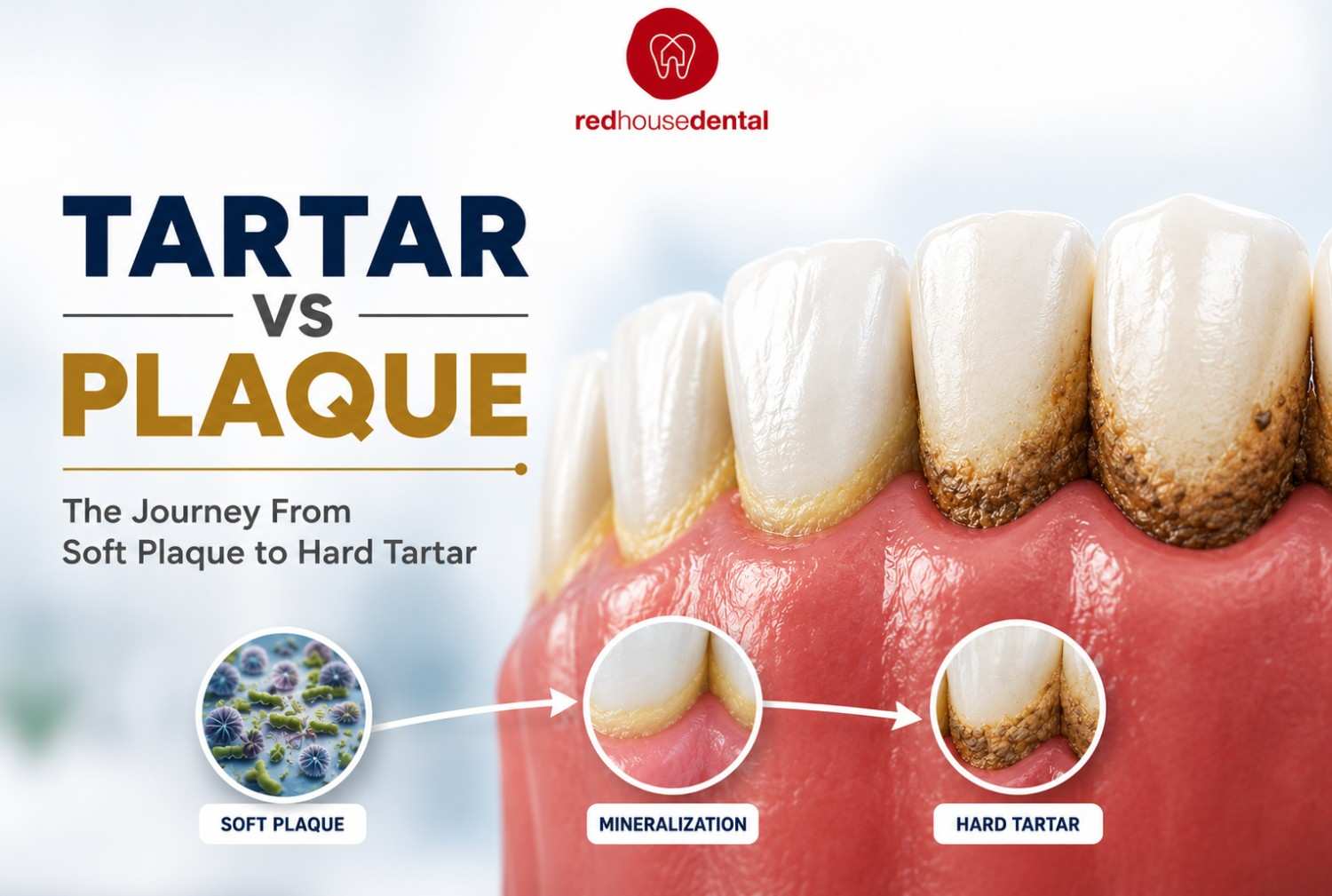
Plaque that nobody clears away eventually picks up minerals from saliva. Hardens. Becomes tartar teeth, also called calculus. Simple as that.
Faster than most people expect to. A few hours is all it takes sometimes. That is the bit that usually surprises patients when it is properly explained to them.
What Tartar Looks Like
- Shows up yellow or brownish on the tooth surface
- Rough enough to feel with a tongue or fingernail
- Settles along the gumline and below it in spots that a toothbrush cannot reach
- A rough surface makes fresh plaque more likely to cling, restarting the whole cycle.
The CDC notes that once tartar spreads below the gumline, a dental professional needs to step in. Left alone, it progresses toward serious periodontal disease.
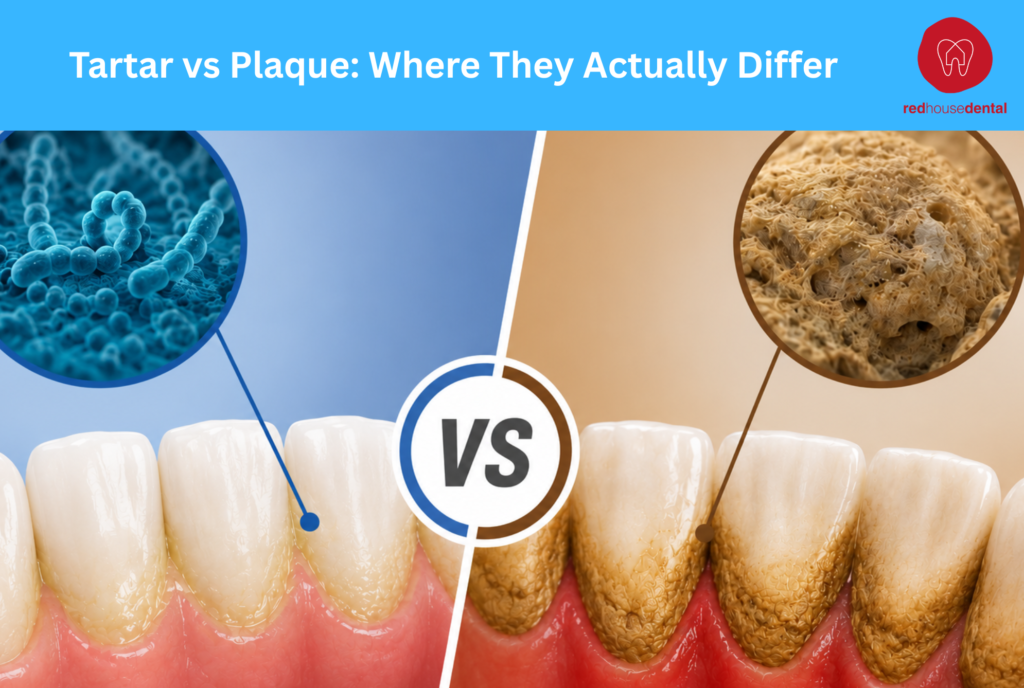
Tartar vs Plaque: Where They Actually Differ
Tartar vs plaque comes down to three clear things.
How They Build Up
- Plaque builds up after every meal and drink throughout the day.
- With consistent brushing and flossing, plaque gets cleared before it hardens.
- Without that consistency, plaque sits long enough to calcify into something much harder to deal with.
How They Look and Feel
- Plaque feels fuzzy when the tongue runs across the teeth.
- Colourless and hard to see
- Tartar feels rough and shows up as a yellow or brownish discoloration
- Hard to miss once it has built up enough to be noticeable
How They Come Off
- Plaque comes off with brushing and flossing at home.
- Tartar does not shift with home care, no matter what.
- Tartar needs a dental professional and specialized instruments to remove it.
Dental tartar vs plaque is really that simple at its core. One is something handled at the sink. The other genuinely needs a dental chair.
What Happens When Tartar Gets Left Alone
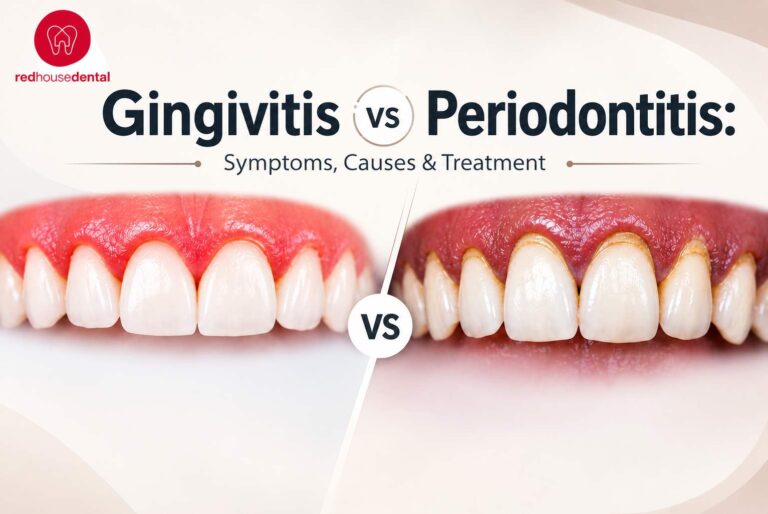
Gums become swollen. Red. Start bleeding when brushing or flossing. That is gingivitis, the early stage of periodontal disease.
Without treatment, gingivitis keeps going. Gums start separating from teeth. Things loosen up. In the worst cases, the teeth come out altogether.
The CDC puts the number of adults over 30 with some form of periodontal disease at close to 48 percent. A significant portion of those cases trace back to plaque that was never managed before it hardened into tartar.
How to Stop Tartar from Building Up
Clearing plaque before it ever hardens is really the whole game here.
Daily Habits That Actually Work
- Brush twice a day, two full minutes, fluoride toothpaste with antiplaque action
- A powered toothbrush genuinely outperforms a manual one for plaque removal, according to research from 2013
- Floss daily without skipping, since a brush cannot get between teeth, no matter how good it is
- Brush after something sweet rather than waiting until the end of the day
- An antibacterial mouthwash picks up what brushing leaves behind
Diet and Lifestyle That Help
- Sugary and starchy foods give bacteria direct fuel to produce more acid
- Crunchy raw vegetables like carrots help clean tooth surfaces naturally while chewing
- Drinking water consistently rinses food particles away between meals
- Smoking and tobacco noticeably speed up both plaque buildup and tartar formation
Dental Sealants Worth Asking About
The CDC states that dental sealants on molars may protect against 80 percent of cavities for 2 years and continue to prevent around 50 percent for up to 4 years. Worth raising with a dentist if cavities keep showing up despite a solid routine.
How to Get Rid of Hard Plaque on Teeth
A lot of people go searching for this question “how to get rid of hard plaque on teeth?” hoping there is some home method that works.
Once plaque has hardened into tartar, harder scrubbing, baking soda, oil pulling, all sorts of things, none of them touch calcified tartar once it has mineralized onto the tooth.
The only real way to remove hard, mineralized plaque from teeth is professional scaling. Trying to scrape it off at home risks scratching enamel and damaging gum tissue, which creates new problems on top of the existing ones.
What Tartar Removal Actually Involves
Tartar removal happens through scaling.
- A dentist or hygienist uses specialized instruments to break down and clear calcified deposits.
- Sometimes ultrasonic tools, sometimes manual hand instruments
- Clears buildup from tooth surfaces and along the gumline
Where tartar has worked its way below the gumline, root planing follows.
- Smooths the root surface so bacteria struggle to grip back on
- Reduces the chance of the same spots getting reinfected quickly
Regular tartar removal visits every six months keep the whole cycle from falling behind the home routine.
Why Red House Dental
Red House Dental is at 38 Arnold Crescent, Richmond Hill, ON.
Plaque management and tartar removal sit at the centre of preventive care here, not something briefly mentioned at the end of an appointment.
- Every checkup includes a proper look at where plaque and tartar might be quietly building up.
- Where tartar removal is needed, that gets done and explained clearly
- Where home habits could be stronger, that conversation happens practically and without judgment.
The dental clinic accepts the Canadian Dental Care Plan for eligible patients.
Frequently Asked Questions (FAQs)
What is the real difference between tartar and plaque?
One stays soft and comes off at the sink with a toothbrush and floss. The other has hardened right onto the tooth surface, and nothing short of professional instruments will shift it. That is really the whole story.
What is plaque actually made of?
According to the American Dental Association, over 500 species of bacteria are found in saliva and on whatever food particles are in the mouth. It builds up on teeth continuously throughout the day, whether anyone notices it happening or not.
Can plaque on gums cause problems even when teeth look completely fine?
Absolutely, yes. The gumline is actually where trouble tends to start first, often well before anything on the visible tooth surface looks wrong. The plaque sitting right there triggers inflammation quietly while everything above it appears clean.
Is there actually a way to get rid of hard plaque on teeth without seeing a dentist?
Honestly, no. People try harder brushing, baking soda, oil pulling, and all sorts of things. None of it touches calcified tartar. Once it has mineralized onto the tooth, professional scaling is the only thing that actually removes it.
How often should tartar removal actually happen?
Six months is what suits most people. Some build tartar faster than others or already have gum disease developing, and for those patients, every three to four months tends to make more sense.