It’s normal to feel anxious when your dentist recommends a root canal. You may wonder what could go wrong and how you will feel afterward. This guide explains the root canal treatment side effects in simple, easy-to-understand terms.
What Is Root Canal Treatment?
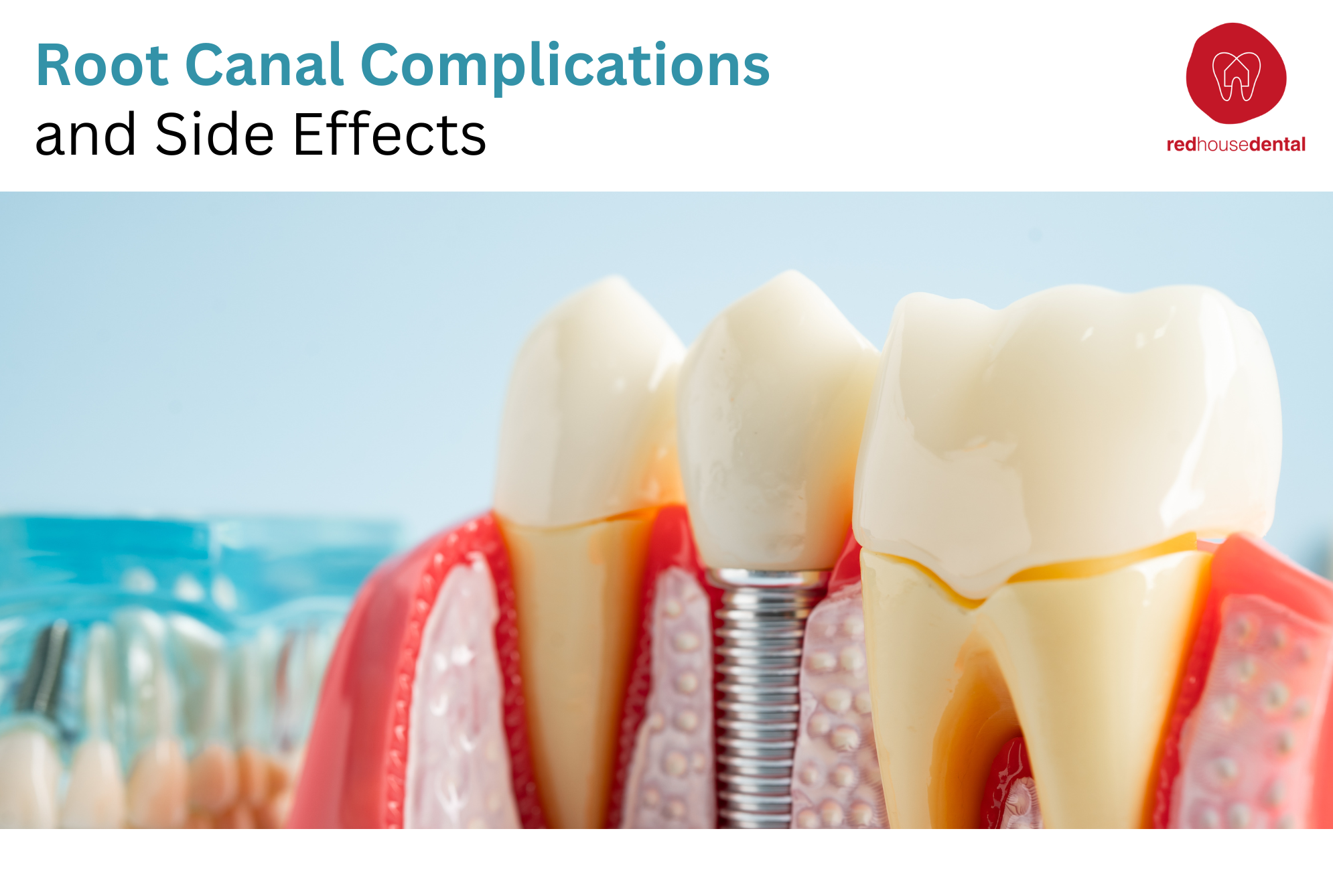
It is good to know what a root canal treatment is before knowing the potential side effects. Root canal is a dental surgery that is aimed at saving a tooth which has become severely gnarled or infected. The pulp is a soft tissue in the inside of every tooth where nerves and blood vessels are found. Once this pulp is infected by deep decay, cracks, or trauma, it may result in serious swelling and pain. When performing root canal, your dentist attempts to painstakingly debride and cleanse as well as disinfect the inner canals and then seal the opening using a protective cover to avoid further infections.
At Red House Dental, Richmond Hill, we have skilled dental staff who undertakes root canal cases in modern technology with high precision methods. Our attention is laid on ensuring that the process is as comfortable and stress free as can be. Through the utilization of digital images, advanced anesthesia and gentle treatment, we make sure that the patients will undergo minimum discomfort during and following the treatment.
No root canal is complete without not only saving you pain but also saving your natural tooth that will enable you keep your natural smile and healthy chewing capabilities many years to come.
Common Root Canal Treatment Side Effects
Most people experience some level of pain after a root canal. Here’s what usually happens:
- Soreness and Tenderness
For a few days, your tooth and the surrounding area may hurt. This is entirely normal. Your tooth needs to have the surrounding bone healed. Suppose it was a bruise—that will take time to heal up. This is typically managed through the use of over-the-counter pain medication, which can be purchased at the store.
- Sensitivity
Your teeth can be sensitive when you bite down or eat hot or cold food. This sensitivity often subsides in a week or two. Call your dentist in case it is prolonged.
- Swelling
A certain gum or cheek swelling is normal. It should get better each day. When it worsens or fails to improve within two days, it will be an indication that you need to call your dentist immediately.
- Slight Bleeding
Once you brush your teeth, particularly in the treated region, you may notice some light bleeding. This should be ended within a day or two.
Root Canal Complications
The majority of root canals are effective, with complications possible. Here are the main ones:
- Infection Returns
Even treatment occasionally reoccurs with infection. This can happen when there are not enough bacteria that have been cleaned or when the seal is not so good. Some of the symptoms include pain that worsens, swelling, or a bitter taste in your mouth.
- Tooth Becomes Weak
After a root canal, the tooth no longer receives blood flow, which can make it more brittle over time. This can lead to its brittle nature over time. That is why dentists often recommend placing a dental crown afterward to strengthen and protect the treated tooth.
- Tool Breaks Inside
It is rare for a small dental tool to become dislodged within a tooth during treatment. This is one of the things that good dentists can usually manage without much trouble, provided that it requires some extra time for treatment.
- Crack in the Tooth
The root canal may not be able to repair a tooth that has a crack that was not visible. The cracks may appear during or after the treatment in some instances.
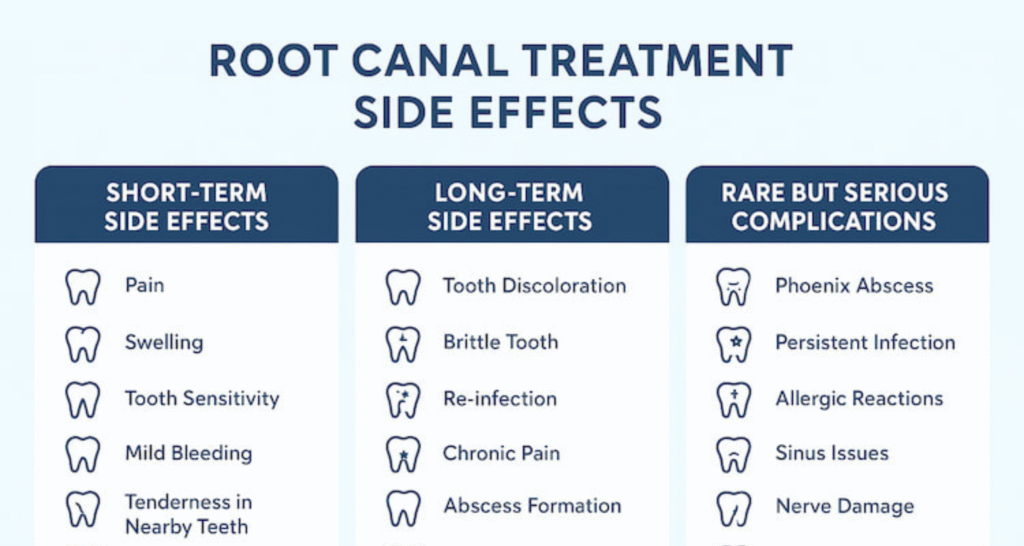
Root Canal Side Effects (Long-Term)
Root canal treatment has side effects, which are not long-term for most people. However, among what can be accomplished in months or years, the following are only a few:
- Tooth Colour Changes
Your tooth may get darker. It is so because the tooth will no longer be alive. It is not destructive; it is a tiny transformation of colour. If it is annoying you, consider asking your dentist if it is possible to whiten or add a crown.
- Need for More Treatment
The second root canal may be necessary on other teeth if they were incompletely cleaned during the initial procedure. This is called retreatment. Although it is not common, it still occurs.
- Tooth Loss
In rare cases, extraction of the tooth may be necessary due to the severity of the complications or excessive destruction of the tooth’s structure. Nevertheless, remember that the primary aim of a root canal is to save your tooth, and in most cases, it is successful.
How to Avoid Root Canal Complications
In order not to cause trouble, you may do several things:
- Post-treatment instructions.( Always follow a dentist’s instructions with caution.)
- Use all drugs as directed.
- Do not chew the tooth that has been treated until it is cleared that you can chew by your dentist.
- Clean but brush gently.
- Make a follow-up appointment.
- Wear a dental crown as advised by your dentist to protect the treated tooth.
When to Call Your Dentist
Call Red House Dental immediately because you found:
- Pain that worsens instead of improving.
- Two days afterward, the swelling became larger.
- Fever
- You have a wrong bite or a lopsided bite.
- And such hurt with biting.
- Pus or drainage in the region.
Root Canal Therapy at Red House Dental
We understand that dental treatments can be scary at Red House Dental, a dental clinic in Richmond Hill, We treat infected teeth and relieve pain with gentle and precise root canal therapy. We are also well-staffed with Dr. Ria Pudjo, Dr. Kavita Gupta, Dr. Sandeep Tayal, and Dr. Susie Ang, who take time to explain everything to us before we start.
Treatment is made more comfortable and accurate with the aid of modern technology. In the event of a same-day pain or dental emergency, we have facilities to keep you going. We are also open to the Canadian Dental Care Plan (CDCP), which can make treatment more affordable.
Conclusion
Root canal treatment has short but not serious side effects. Most of them are cured within a couple of days. The cases of root canal complications are not rampant, and severe health issues are not a concern; a qualified dental practice is the place to be.
In most patients, there is no long-term side effects of root canal treatment. It will not be lost, as the treatment will help you keep your natural tooth, which is always preferable to losing it.
FAQs
1. Does a root canal hurt?
The procedure is not painful as most patients experience no or minimal pain due to the use of local anesthesia by dentists. There can be some mild pain following this, but this passes off in days.
2. What is the recovery period of a root canal?
The recovery normally requires a few days. The soreness and sensitivity start to disappear slowly, and the majority of individuals go back to normal eating and chewing in a week.
3. Can a root canal fail?
Root canals are very successful yet may fail in case of bacteria remaining or cracks on a tooth. The tooth can be saved through retreatment or secondary restoration.
4. Does a tooth after a root canal look different?
Since the tooth is not alive anymore, it may become darker with time. The appearance can be enhanced with crowns or whitening.
5. Is it possible to eat normally after a root canal?
Do not chew up the treated tooth until you see your dentist. The first few days are supposed to be taken with soft food to enable healing.
6. Do I still require a crown after root canal?
The dentists normally prescribe the use of a crown to safeguard the tooth and stop fractures, particularly the back teeth that are involved in hard chewing.